Can men get UTIs?
Yes. Urinary tract infections are far less common in men than in women, but they are not rare, and they tend to mean something different. The Infectious Diseases Society of America notes that UTI is uncommon in men before age 50, yet a man's lifetime risk is about 14%. A systematic review in BJGP Open put the figure at around 20% of men over a lifetime, with community incidence of 0.9 to 2.4 cases per 1,000 men younger than 55, rising to 7.7 per 1,000 at age 85 and older. In a woman, a bladder infection is usually a stand-alone event. In a man, it is often a signal that something upstream, most commonly the prostate, is not working the way it should.
Why UTIs are less common in men, and why that matters
Anatomy explains most of the gap. According to the National Institute of Diabetes and Digestive and Kidney Diseases (NIDDK), women have a short urethra located close to the anus, a source of bacteria. The male urethra is longer and runs through the prostate and penis, so bacteria from the skin and bowel have a much longer distance to travel before they reach the bladder. NIDDK states plainly that men under 50 rarely get bladder infections.
That protection is exactly why a UTI in a man deserves attention. When bacteria do manage to establish an infection, it is usually because urine is not draining properly, a foreign body such as a catheter is present, or the prostate itself is harboring infection. For decades, every UTI in a man was labeled "complicated" for this reason. Current guidelines are more precise: the 2025 IDSA guideline defines a complicated UTI by evidence that infection has spread beyond the bladder, such as fever, systemic signs, bacteremia or flank pain, or by the presence of a catheter, stent or nephrostomy tube, and it states that both men and women can now meet the criteria for uncomplicated infection. The European Association of Urology likewise no longer treats male sex alone as a complicating factor. What has not changed is the practical point: after a first UTI, a man should be checked for the reason it happened. A 2026 review in Infectious Diseases Now notes that UTIs in men frequently arise from anatomical or functional abnormalities of the urinary tract, and recommends a systematic search for them.
What causes UTIs in men? 10 causes and risk factors
Most UTIs are caused by bacteria; fungi are a rare cause, per NIDDK. In prostate infections, Escherichia coli accounts for roughly 50% to 90% of cases, according to StatPearls. The question that matters clinically is why the bacteria were able to take hold. These are the causes and risk factors a urologist looks for:
- Enlarged prostate (BPH). Benign prostatic hyperplasia is the leading underlying cause of UTI in men over 50, according to the 2026 review. A large prostate narrows the outflow channel and makes emptying less efficient.
- Incomplete bladder emptying. Urine left behind after voiding (post-void residual) is a reservoir for bacteria. NIDDK lists difficulty emptying the bladder as a risk factor.
- Urinary blockage. Any obstruction of urine flow, including urethral stricture, raises risk; NIDDK lists blockages of the urinary tract specifically.
- Kidney and bladder stones. Stones can harbor bacteria and block drainage. Imaging to look for stones is part of the workup for repeat infections, per NIDDK.
- Urinary catheters. Indwelling and intermittent catheters give bacteria a direct route into the bladder; both appear in the IDSA definition of complicated UTI.
- Ureteral stents and nephrostomy tubes. Any tube placed in the urinary tract carries the same risk.
- Bacterial prostatitis. Infection in the prostate can seed the bladder and cause infections that keep coming back; about 5% to 10% of acute cases progress to chronic bacterial prostatitis (StatPearls).
- Diabetes or a weakened immune system. Both are listed by NIDDK as factors that make infection more likely.
- A previous UTI. A history of UTI is itself a risk factor (NIDDK), which is one reason recurrent infections should prompt a full evaluation.
- Age and sexual activity. Incidence rises steadily with age (Farrell et al.), and NIDDK lists being sexually active as a risk factor.
UTI symptoms in men
A bladder infection in a man looks much like one in a woman. NIDDK lists burning with urination; frequent or intense urges to urinate even when little urine comes out; discomfort in the lower abdomen; and urine that is cloudy, bloody or strong-smelling. Men with an enlarged prostate may also notice that an already weak stream gets worse, or that they cannot empty fully.
Signs the infection has spread
Fever and chills, nausea or vomiting, and pain in the back, side or groin suggest a kidney infection, and NIDDK advises contacting a provider right away. In men, fever with urinary symptoms also raises the possibility of acute bacterial prostatitis, discussed below.
To discuss your symptoms and care options, request a consultation with the 1Prostate team.
When a UTI is an emergency
Go to an emergency department, or call us the same day, if you have fever with shaking chills, cannot pass urine at all, feel lightheaded or confused, or have severe flank or pelvic pain. NIDDK specifically lists complete inability to urinate and painful, urgent urination with fever and chills as reasons to seek immediate medical care. Hospital admission is appropriate for sepsis, urinary retention or risk factors for resistant bacteria, per StatPearls.
UTI or STI? Urethritis is a different problem
In younger, sexually active men, burning with urination is often urethritis, an inflammation of the urethra usually caused by a sexually transmitted infection, rather than a bladder infection. The CDC describes urethritis as painful urination, urethral itching and a mucoid or purulent discharge, caused by gonorrhea, chlamydia, Mycoplasma genitalium and other organisms. The treatment is different, and partners need to be treated. The CDC recommends that every man with suspected urethritis be tested for gonorrhea and chlamydia with a nucleic acid amplification test, and urine is the preferred specimen. A standard urine culture will not diagnose these infections, which is one more reason not to accept a quick antibiotic prescription without testing.
Acute bacterial prostatitis
Acute bacterial prostatitis is a sudden infection of the prostate. NIDDK describes the symptoms as coming on suddenly and severely: urinary frequency and urgency, fever, chills, and burning or pain with urination. StatPearls adds malaise, body aches and pelvic pain, and notes that the prostate is usually enlarged and exquisitely tender. The prostate should be examined gently; vigorous prostate massage can make the infection worse. Complications include sepsis, epididymitis, prostate abscess and chronic pelvic pain. Treatment is longer than for a bladder infection: NIDDK notes that oral antibiotics are typically given for at least 2 weeks, and severe cases require hospitalization for intravenous antibiotics followed by 2 to 4 weeks of oral therapy. The IDSA guideline likewise notes that men with febrile UTI in whom prostatitis is suspected may benefit from 10 to 14 days of treatment.
How a UTI is diagnosed in men
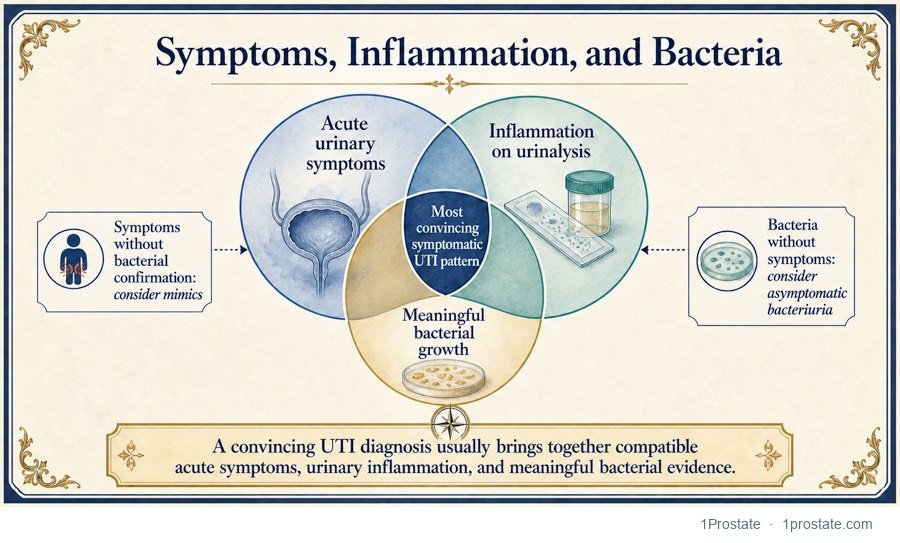
- Urinalysis checks for white blood cells and blood in the urine (NIDDK).
- Urine culture with sensitivities identifies the bacteria and which antibiotics will work. In a man, the sample should be collected before the first dose of antibiotics, because treatment can prevent the bacteria from growing in the lab. The EAU recommends culture and susceptibility testing for kidney infection and for recurrent infection.
- STI testing when urethritis is possible, as above.
- Digital rectal exam to assess the prostate for tenderness or enlargement.
- Post-void residual measurement. A quick bladder ultrasound after urinating shows how much urine is left behind. Under 100 mL is considered normal and over 200 mL indicates inadequate emptying (StatPearls).
- Blood tests when kidney infection is suspected, to assess severity and kidney function (NIDDK).
When imaging and cystoscopy are needed
The 2026 review recommends that the first-line workup after a first male UTI include a targeted history, a rectal exam, a prostate symptom score, and urinary tract ultrasound with post-void residual measurement. Further urologic evaluation is advised for kidney infection, urinary retention, visible blood in the urine, a residual over 100 mL, recurrent infection, age under 40, or an abnormal ultrasound. CT or MRI is reserved for suspected obstruction, severe illness or treatment failure. Cystoscopy, a direct look at the urethra and bladder with a thin scope, is used to find the cause of repeat infections (NIDDK). A PSA test is not recommended routinely after a UTI, because infection can raise PSA for up to three months and a first UTI is not linked to prostate cancer.
Treatment: which antibiotic, and for how long
A UTI is treated with antibiotics, and the best choice is the one the culture shows your bacteria are sensitive to. Current IDSA guidance calls for switching to a targeted antibiotic based on urine culture results as soon as they are available.
Duration has been the subject of the most useful recent evidence. In a randomized, double-blind trial published in JAMA in 2021, 272 afebrile men with UTI at two Veterans Affairs medical centers, median age 69, took ciprofloxacin or trimethoprim-sulfamethoxazole for 7 days and were then randomized to either 7 more days of antibiotic or placebo. Symptoms resolved in 93.1% of the 7-day group and 90.2% of the 14-day group, meeting the test for noninferiority. Recurrence within 28 days was 9.9% versus 12.9%, and adverse events were 20.6% versus 24.3% (CIDRAP). For men without fever, a 7-day course of these antibiotics is a reasonable alternative to 14 days. For complicated UTIs, including kidney infection, in patients who are improving, the 2025 IDSA guideline suggests 5 to 7 days of a fluoroquinolone or 7 days of another antibiotic rather than 10 to 14. Fever with suspected prostatitis is the main exception that calls for a longer course.
Two practical cautions. First, not every antibiotic that works for women works for men: the EAU advises that nitrofurantoin be used only when prostatic involvement has been reliably excluded, because it does not reach adequate levels in the prostate. Second, do not self-treat with leftover pills or an online prescription. Without a culture, you risk the wrong drug, a partially treated prostate infection, and a missed obstruction or stone.
Recurrent UTIs and prevention
In men, repeat infection is usually a sign that the underlying cause has not been fixed. Prevention therefore starts with finding and treating that cause: relieving obstruction from BPH or stricture, removing stones, fully treating prostate infection, and minimizing catheter use. Alpha-blockers are the first-line medication for BPH-related urinary symptoms, according to the 2026 review. NIDDK suggests that drinking plenty of fluids, with water being best, may help prevent bladder infections. Good blood sugar control matters for men with diabetes. Popular remedies such as cranberry have been studied mostly in women; the EAU guideline offers no male-specific prevention recommendations.
When to see a urologist
See a urologist if you have had a UTI with fever, a kidney or prostate infection, two or more infections, blood in the urine, a weak stream or trouble emptying, a history of stones, or a UTI before age 40. These are the situations in which an underlying cause is most likely and most treatable.
UTI evaluation in Manhattan and Forest Hills
At 1Prostate, board-certified urologist Dr. David Shusterman evaluates men with urinary tract infections, prostatitis and recurrent infections, with the goal of finding and treating the cause, not just the current infection. Offices are at 800 Second Avenue, 9th Floor, in Midtown Manhattan, and 69-15 Yellowstone Blvd in Forest Hills, Queens. Same-week appointments are available. Call (212) 991-9991 to schedule.
Frequently asked questions
Can men get a UTI?
Yes. UTIs are less common in men because the male urethra is longer, but IDSA estimates a man's lifetime risk at about 14%, and risk rises with age. Because the urethra protects men, a UTI in a man usually has a cause, most often an enlarged prostate or incomplete bladder emptying, and should be evaluated rather than simply treated.
What are the symptoms of a UTI in men?
Typical symptoms are burning with urination, frequent or urgent need to urinate even when little comes out, lower abdominal discomfort, and cloudy, bloody or strong-smelling urine. Fever, chills, nausea, or pain in the back, side or groin suggest the infection has spread to the kidney or prostate and needs prompt medical care.
How do men get a UTI?
Bacteria, usually E. coli from the skin or bowel, travel up the urethra into the bladder. In men this usually succeeds when urine does not drain well, as with an enlarged prostate, stricture or stones, or when a catheter or stent is present. Diabetes, a weakened immune system, prior UTIs and prostate infection also raise risk.
How long are antibiotics taken for a UTI in men?
For men without fever, a 2021 JAMA trial found 7 days of ciprofloxacin or trimethoprim-sulfamethoxazole worked as well as 14 days. The 2025 IDSA guideline suggests 5 to 7 days for many complicated UTIs in patients who are improving. Fever with suspected prostatitis usually requires a longer course, often 10 to 14 days or more.
Is burning when I urinate a UTI or an STI?
It can be either. In younger, sexually active men, burning with a discharge often means urethritis from gonorrhea, chlamydia or Mycoplasma genitalium. The CDC recommends testing all men with suspected urethritis for gonorrhea and chlamydia using a urine NAAT. A routine urine culture does not detect these infections, so both tests may be needed.
Sources
- Definition & Facts of Bladder Infection in Adults (NIDDK)
- Symptoms & Causes of Bladder Infection in Adults (NIDDK)
- Diagnosis of Bladder Infection in Adults (NIDDK)
- Bladder Infection (Urinary Tract Infection—UTI) in Adults (NIDDK)
- Prostatitis: Inflammation of the Prostate (NIDDK)
- IDSA 2025 Guideline on Complicated Urinary Tract Infections
- IDSA 2025 cUTI Guideline Executive Summary
- What's New in the 2025 IDSA Updates for Complicated UTIs? (The Hospitalist)
- EAU Guidelines on Urological Infections
- CDC STI Treatment Guidelines: Diseases Characterized by Urethritis and Cervicitis
- Drekonja et al. Effect of 7 vs 14 Days of Antibiotic Therapy on Resolution of Symptoms Among Afebrile Men With UTI. JAMA 2021 (PMID 34313686)
- Trial supports shorter antibiotics for UTIs in men (CIDRAP)
- Farrell et al. Treatment of uncomplicated UTI in males: a systematic review. BJGP Open 2021
- Soudais et al. Which investigations should be performed after a first episode of UTI in men? Infect Dis Now 2026
- Acute Bacterial Prostatitis (StatPearls, NCBI Bookshelf)
- Bladder Post Void Residual Volume (StatPearls, NCBI Bookshelf)
Share this blog!
Facebook Twitter LinkedInRecent Post

Managing Chronic Prostatitis: Natural Remedies That Help
Read More »
The Role of Curcumin in Prostate Health
Read More »